As we plunge into the 2010 election season, so many politicians and pundits are exploiting fear--the fear of time honored institutions like marriage, family, and racial hegemony changing until they are no longer recognizable. At least, that's what some would like you to believe. A vocal segment of the population would like to return to small town (as in, WASP) values, but from 1992-1996 there was a drama by David E. Kelly on CBS that showed how complex and diverse small town values can be.
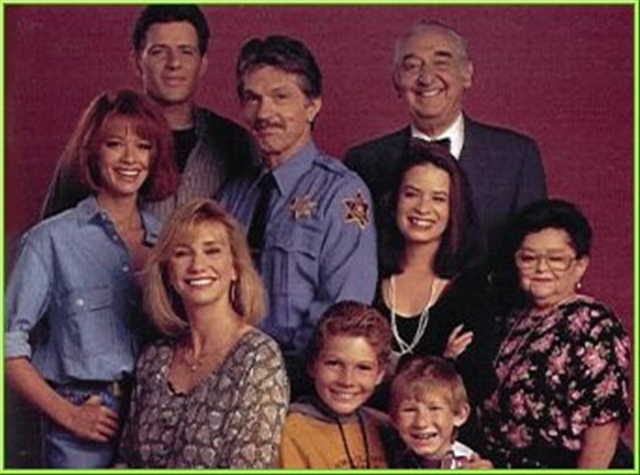
Picket Fences was about the citizens living in the small town of Rome, Wisconsin, who find themselves dealing with contemporary issues and unusual problems. Jimmy Brock is the town's sheriff. His wife Jill is the town's doctor, who somehow has up-to-date information on the latest diseases and treatments. Kimberly, Jimmy's daughter from a previous marriage, is trying to find an identity outside of the town pillars who are her parents. Jimmy and Jill's sons, Matthew and Zack, are two creative troublemakers. The show also follows people who regularly encounter the Brocks. Kenny and Maxine are two deputies who just want the chance to shine on hard cases. Carter is the pathologically lonely medical examiner, who chose his career before shows like CSI made forensic pathology sexy. Douglas Wambaugh is a Jewish lawyer who represents every defendant in town before Judge Bone, a curmudgeon who manages to abolish the jury system and whose post-verdict catchphrase is, "Now, get out!"
I'm not sure why I started renting the Season 1 DVDs from the library. Maybe because it takes place in my adopted state, with plots about the town's dairy industry and talking with venom about "a new hot-shot lawyer from Madison." Maybe because DVDs have allowed me to watch so many shows that seemed lost to nostalgia. Nostalgia is powerful, to the point where just hearing the theme music makes me feel happy and safe.
Seriously, doesn't that make you think of quiet streets strewn with autumn leaves, and snuggling up next to a fireplace, and pies cooling on the window sill? As much comfort as that music makes me feel, however, the show's purpose is to puncture that sense of comfort.
When I first told my mom that I had started watching Picket Fences DVDs I borrowed from the library, she made a face and said, "Ugh, why?" I was surprised by her reaction. After all, I often watched it with her when I was in 2nd-5th grade. (When I asked her why she let me watch it, considering the adult subject matter, she replied, "I think I let you watch because of Fyvush Finkel.") The show won 14 Emmy awards, including the award for Outstanding Drama two years in a row. Indeed, it is one of the few shows to win Outstanding Drama, Lead Actor, and Lead Actress in its debut season. The actors have continued to have notable careers, particularly Don Cheadle, who had one of his first major roles as DA John Littleton starting in season 2. (Unless you would rather count his time on Golden Palace, the Golden Girls spinoff, as his first major role.) I've even spotted a young Elisabeth Moss playing Zack's classmate, a precocious girl who brings a severed hand for Show and Tell and admonishes Kimberly for being caught having "dirty bad naked sex!"
So why did my mom react with disgust? The show's raison d'etre was to push boundaries. The only way to describe it is as a family/legal/medical/cop dramedy. When I showed my fiance the pilot episode, in which Carter suspects foul play after the Tin Man dies backstage during a community production of The Wizard of Oz, he said, "It's trying to be everything at once." He sounded exhausted when he said that. The show also took on just about every controversial issue possible, and sometimes more than once. For example, as part of my TV discussion series on reproductive rights, I told my fellow volunteer about the episode "Cross Examination," in which a comatose car crash victim is found to be pregnant even though she is a virgin, and the town churches file a restraining order to stop the hospital from performing a life saving abortion on the grounds that the fetus could be the second coming of Jesus. When I later told her about the episode "The Body Politic," in which a man tries to keep his brain-dead wife on life support because she is pregnant, the volunteer interrupted, "Wait--didn't you tell me about this already?"
If you mention the show to anyone who was a teenager or adult at the time it aired, they are probably going to respond, "Wasn't that the show with the pregnant cows?" They are referring to the 3rd season episode "Away in a Manger," in which the police uncover an operation in which a local fertility doctor uses cows as surrogate mothers for human fetuses. By most accounts, this is when the show started to go downhill. By season four, David E. Kelly left and the writing deteriorated. Plots became weird just for the sake of being weird, like one where there is a shooting in town . . . and the only witness is His Holiness the Pope! At the same time, they kept returning to tired plots of the Brocks' marriage troubles and Kenny and Max's "will they or won't they?" romantic tension. The show finally limped across the finish line at the end of season four, with a fraction of the critical acclaim it once had.
Looking back, some elements come across as dated. The "controversial issue of the week" type TV shows were definitely a product of the 1990's that television has either left behind or integrated into a more complex serialized narrative. The medical issues also suffer from hindsight. In the episode "Frosted Flakes," a couple tries to have their cancer-stricken son cryogenically frozen with the hope that he can be unfrozen when a cure is found. Carter claims that cryogenics is the way of the future and breakthroughs are "just around the corner." Almost 20 years later, we have yet to reach that corner. You know how when you thaw out a frozen strawberry, it turns into a gooey blob? Now imagine that happening to a human. Needless to say, I'm glad that Judge Bone ruled against the parents on that one.
The Emmy Award-winning 1st and 2nd seasons, however, are delightfully engaging. The actors portray their characters with earnestness. Kimberly actually cares about finding her identity, a spiritual sister to Angela Chase and Daria Morgendorffer. Her type of teen girl character seemed to have gone out of style with the invention of texting. Douglas Wambaugh is such an outrageous character that in one episode, the local synagogue tries to excommunicate him for embodying the Jewish stereotype of the shyster lawyer. He is the comedic center of the show, but he cares deeply about ensuring that everybody has a chance at justice. His friendship with Judge Bone also provided much heart to the show as it lost creative steam. Jimmy and Jill struggle between their personal preferences for liberal views and their desire to protect their children and the town. For at least 3/4 of the show, all of the characters are at their A-game.
The issues of the week are presented with complete seriousness from both sides, no matter how outrageous their claims. The writers were willing to present both sides as having valid claims, a quality that seems lost in a time when the entertainment industry must counteract Palin/Beck/Tea Party soundbites with equally strong rhetoric. The best example of this is in the notable episode "The Body Politic," in which a dentist is fired from a city contract for not disclosing that he is HIV positive. The dentist sues the city and Jill speaks in his defense, rightly pointing out that medical professionals are not required to disclose their status and that with proper procedure, it's impossible for a patient to catch the virus. When Wambaugh cross-examines her, he points out that while all of the above is true, patients also have a right to start or stop seeing medical professionals based on any criteria they want--and that by not disclosing his status, the dentist is robbing the patient of that right. Jill sputters that patients are wrong if they let bigotry determine which doctors they see, but Wambaugh has proven his point. Later, Jill says she doesn't know what is worse--realizing she was wrong, or having Wambaugh do it for her. Judge Bone ends up ruling in favor of the dentist, but it is a bittersweet victory, as he explains, "I can give you your job back, but I can't force patients to sit in that chair."
The first season is on DVD, and both the first and second seasons are available on Hulu (minus six episodes due to music rights issues.) This show has not stayed in the cultural mindset the way other award-winning dramas have, but it deserves a second look. Watch it on a cold winter night, wrapped in a warm blanket. Sip some apple cider and go back to a time when idealism was in the air and it seemed like any issue could be solved with a reasoned discussion.
If you mention the show to anyone who was a teenager or adult at the time it aired, they are probably going to respond, "Wasn't that the show with the pregnant cows?" They are referring to the 3rd season episode "Away in a Manger," in which the police uncover an operation in which a local fertility doctor uses cows as surrogate mothers for human fetuses. By most accounts, this is when the show started to go downhill. By season four, David E. Kelly left and the writing deteriorated. Plots became weird just for the sake of being weird, like one where there is a shooting in town . . . and the only witness is His Holiness the Pope! At the same time, they kept returning to tired plots of the Brocks' marriage troubles and Kenny and Max's "will they or won't they?" romantic tension. The show finally limped across the finish line at the end of season four, with a fraction of the critical acclaim it once had.
Looking back, some elements come across as dated. The "controversial issue of the week" type TV shows were definitely a product of the 1990's that television has either left behind or integrated into a more complex serialized narrative. The medical issues also suffer from hindsight. In the episode "Frosted Flakes," a couple tries to have their cancer-stricken son cryogenically frozen with the hope that he can be unfrozen when a cure is found. Carter claims that cryogenics is the way of the future and breakthroughs are "just around the corner." Almost 20 years later, we have yet to reach that corner. You know how when you thaw out a frozen strawberry, it turns into a gooey blob? Now imagine that happening to a human. Needless to say, I'm glad that Judge Bone ruled against the parents on that one.
The Emmy Award-winning 1st and 2nd seasons, however, are delightfully engaging. The actors portray their characters with earnestness. Kimberly actually cares about finding her identity, a spiritual sister to Angela Chase and Daria Morgendorffer. Her type of teen girl character seemed to have gone out of style with the invention of texting. Douglas Wambaugh is such an outrageous character that in one episode, the local synagogue tries to excommunicate him for embodying the Jewish stereotype of the shyster lawyer. He is the comedic center of the show, but he cares deeply about ensuring that everybody has a chance at justice. His friendship with Judge Bone also provided much heart to the show as it lost creative steam. Jimmy and Jill struggle between their personal preferences for liberal views and their desire to protect their children and the town. For at least 3/4 of the show, all of the characters are at their A-game.
The issues of the week are presented with complete seriousness from both sides, no matter how outrageous their claims. The writers were willing to present both sides as having valid claims, a quality that seems lost in a time when the entertainment industry must counteract Palin/Beck/Tea Party soundbites with equally strong rhetoric. The best example of this is in the notable episode "The Body Politic," in which a dentist is fired from a city contract for not disclosing that he is HIV positive. The dentist sues the city and Jill speaks in his defense, rightly pointing out that medical professionals are not required to disclose their status and that with proper procedure, it's impossible for a patient to catch the virus. When Wambaugh cross-examines her, he points out that while all of the above is true, patients also have a right to start or stop seeing medical professionals based on any criteria they want--and that by not disclosing his status, the dentist is robbing the patient of that right. Jill sputters that patients are wrong if they let bigotry determine which doctors they see, but Wambaugh has proven his point. Later, Jill says she doesn't know what is worse--realizing she was wrong, or having Wambaugh do it for her. Judge Bone ends up ruling in favor of the dentist, but it is a bittersweet victory, as he explains, "I can give you your job back, but I can't force patients to sit in that chair."
The first season is on DVD, and both the first and second seasons are available on Hulu (minus six episodes due to music rights issues.) This show has not stayed in the cultural mindset the way other award-winning dramas have, but it deserves a second look. Watch it on a cold winter night, wrapped in a warm blanket. Sip some apple cider and go back to a time when idealism was in the air and it seemed like any issue could be solved with a reasoned discussion.